

The Supreme Court represents Estonia in many international organizations related to the administration of justice and judicial training. Supreme courts engage in active and meaningful cooperation at both the European and global levels, facilitated by international networks that provide platform for common discussion among courts.
The Supreme Court of Estonia holds a unique role, serving simultaneously as the highest court in civil and criminal matters, the highest administrative court, and fulfilling the functions of constitutional review. These are competencies that, in many countries, are distributed among specialized courts. Consequently, the Supreme Court’s international engagement is particularly intensive and diverse.
The primary goal of international cooperation is to strengthen the quality and consistency of the administration of justice by enabling courts to exchange experiences, share best practices, and address urgent issues. It also helps ensure the uniform application of law, supports judicial independence, and generally prepares courts for the challenges of today’s globalized legal environment.
The Supreme Court is most active in the Network of the Presidents of Supreme Judicial Courts of the European Union, the Association of Councils of State and Supreme Administrative Jurisdictions of the European Union (ACA-Europe), the Conference of European Constitutional Courts, the Venice Commission, and the European Judicial Training Network. Meetings of the supreme courts of the Baltic states have also become an annual tradition.
Questions and proposals regarding international relations of the Supreme Court are welcome:
Karin Leichter-Tammisto,
Legal Adviser to the President
Phone: +372 5401 1322
E-mail:
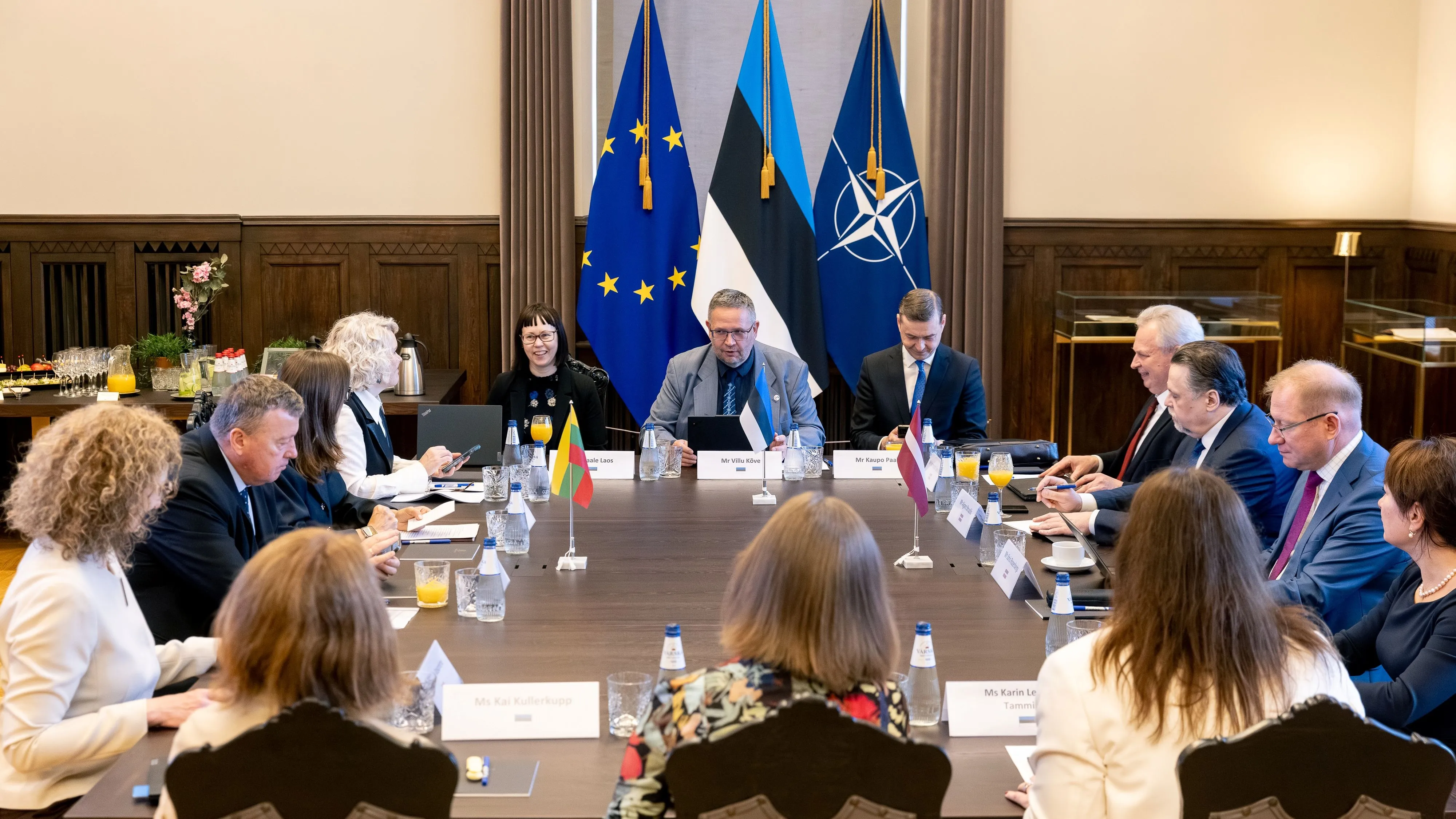
Meeting of representatives of the Baltic supreme courts in Tallinn, May 20–22, 2026. Photo: Jürgen Randma
Member of International Organizations
Network of the Presidents of Supreme Judicial Courts of the European Union
The network has been active since 2004 and includes the presidents of the supreme courts of the 27 EU member states. Associate members include the presidents of the supreme courts of Iceland, Liechtenstein, Norway, and the United Kingdom, while observers include those of Albania, Montenegro, Ukraine, and Serbia. The network's board consists of 11 members, and until November 14, 2025, it included the Chief Justice of the Supreme Court of Estonia, Villu Kõve.
Members meet regularly to discuss common topics, often involving the presidents of the Court of Justice of the European Union (CJEU) and the European Court of Human Rights (ECHR). To facilitate closer cooperation and information sharing, a traineeship program has been established, offering the opportunity to learn about the work of other EU supreme courts. The network has also created a case law portal for convenient access to member states' judicial practice. The contact person for the Supreme Court is Karin Leichter-Tammisto, Legal Adviser to the President.
Judicial Network of the European Union (RJUE/JNEU)
The JNEU is a communication and cooperation channel established by the CJEU in 2017 to promote information exchange between European supreme courts regarding preliminary ruling procedures, improve the quality of judgments at both national and European levels, and ensure the correct interpretation and application of EU law. The network includes the CJEU, the supreme and constitutional courts of EU member states, observers (including the ECHR), and supreme courts of some third countries. The JNEU’s monthly newsletter provides an overview of upcoming rulings, opinions of Advocates General, and scheduled hearings. While communication mainly occurs on a private platform for contact persons, the JNEU has made thematic case law reviews, EU law research, and developments in law accessible to all. The contact person for the Supreme Court is Risto Uustal, Adviser at the Legal Information and Training Department.
Association of Councils of State and Supreme Administrative Jurisdictions of the European Union (ACA-Europe)
ACA-Europe includes the Councils of State, supreme administrative courts of EU member states, and the CJEU. The supreme administrative courts of Albania, Montenegro, Serbia, Turkey, and Ukraine have observer status, while representatives from Norway, Switzerland, and the United Kingdom participate as guests. The goal of the association is to facilitate the exchange of experience and knowledge in the implementation of EU law in supreme courts, thereby improving judges' knowledge of EU law. Through colloquia focusing primarily on administrative law, the association aims to strengthen mutual trust and improve the efficiency of justice in the EU. The association's first colloquium was held in 1968 and in 1998 it was decided to give the organization a permanent form. The board of ACA-Europe consists of ten members, including Ivo Pilving, Chair of the Administrative Law Chamber of the Supreme Court of Estonia. Greece currently holds the presidency; the Baltic states will take over the presidency for 2027–2029.
ACA-Europe also allows judges from member states to participate in an exchange program. Additionally, the network has created the online database Jurifast, which provides access to significant judgments of supreme courts dealing with EU law. In ACA-Europe's online discussion environment, member courts can ask questions and receive quick feedback. The contact person for the Supreme Court is Karmen Kaplinski, Adviser to the Administrative Law Chamber.

Ivo Pilving, Chair of the Administrative Law Chamber of the Supreme Court, at the ACA-Europe seminar held in Helsinki, May 25–27, 2025. Photo: Supreme Administrative Court of Finland
International Association of Supreme Administrative Jurisdictions (AIHJA/IASAJ)
IASAJ was created in 1983 and currently includes 66 supreme administrative courts and councils of state from around the world. The association promotes the exchange of experience among supreme administrative courts and councils of state regarding their functioning and administrative court proceedings. Members meet every three years at an international congress; they also organize seminars, judicial exchange programs, and share useful materials on the network’s website. The next congress will take place in 2028 in Spain. The contact person for AIHJA/IASAJ is Karin Leichter-Tammisto, Legal Adviser to the President.
Conference of European Constitutional Courts (CECC)
CECC unites representatives of 40 European constitutional courts and institutions with the competence of constitutional review. It organizes regular congresses and promotes information exchange on methods of constitutional review and case law. CECC supports the strengthening of the independence of constitutional courts as a fundamental pillar of democracy and the rule of law and pays special attention to the protection of human rights. It also facilitates cooperation between European constitutional courts. The next congress will take place in 2027 in Albania, as the Constitutional Court of Albania holds the presidency of CECC for 2024–2027. The contact person for the Supreme Court is Karin Leichter-Tammisto, Legal Adviser to the President.
European Commission for Democracy through Law (Venice Commission)
The Venice Commission is an advisory body of the Council of Europe (CoE), established in 1990. It has 61 members: 46 CoE member states and 15 non-European countries. The commission's goal is to promote democracy, ensure the protection of human rights, and strengthen the rule of law. The commission consists of independent constitutional law experts who analyze countries' legislation and provide recommendations to align them with European and international standards. Furthermore, the commission develops general standards and guidelines aimed at helping to shape a common constitutional culture.
The Joint Council on Constitutional Justice (JCCJ), which unites representatives of constitutional courts and members of the Venice Commission, operates under the commission. The Supreme Court's contact person for JCCJ is Adviser Karin Leichter-Tammisto. The JCCJ has created the database CODICES, which contains summaries and full texts of more than 11,000 rulings. If comparative analysis or information about another country's legal regulation is needed during a case, it is possible to obtain it through the specifically created Venice Forum.
European Union Forum of Judges for the Environment (EUFJE)
EUFJE was established in 2004, and all European judges interested in environmental law, as well as courts or judicial organizations, can join. Several observers participate in EUFJE's activities, including the European Commission, the Council of Europe, and the UN Environment Programme. The forum's goal is to contribute to better implementation of environmental law domestically, in Europe, and globally. EUFJE organizes an annual conference covering current topics in environmental law. It also contributes to the training of judges and shares various materials among members. Estonia is represented at the forum by Heiki Loot, Justice of the Administrative Law Chamber of the Supreme Court.
European Judicial Training Network (EJTN)
Established in 2000 for the training of judges and prosecutors, EJTN includes 36 training institutions from all EU countries. EJTN also welcomes associate members and observers. The network offers training for judges and prosecutors in the fields of civil, criminal, and administrative law. Language courses and training on EU law are also important. Exchange programs and study visits between courts and institutions of different countries have been established to share and gain practical experience. EJTN has formed several working groups to plan training activities. In recent years, the focus has been on the digitalization working group, which deals with developing the digital skills of judges and prosecutors and searching for opportunities to support justice systems in IT. The Supreme Court's contact person in the network is Liina Reisberg, Head of the Legal Information and Training Department.
World Conference on Constitutional Justice (WCCJ)
WCCJ unites 125 supreme courts, constitutional courts, and constitutional councils from Africa, the Americas, Asia/Oceania, and Europe. WCCJ grew out of various regional cooperation forms of the Venice Commission, which also included judges from outside Europe. The network's goal is to promote global discussion on fundamental rights and democracy. It first met in 2009 and a total of six congresses have been held. The next congress will take place in 2028 in Egypt. The contact person for the Supreme Court is Adviser Karin Leichter-Tammisto.
Superior Courts Network (SCN)
SCN was created in 2015 to facilitate information exchange between the ECHR and the supreme courts of member states. This network includes a total of 112 constitutional and supreme courts from 46 Council of Europe member states. The network also has five observers, including the CJEU. SCN's primary goal is to support courts in implementing the European Convention on Human Rights (ECHR) at the national level. To achieve this goal, summaries and overviews of case law are provided to members, and analyses and guidelines regarding the interpretation of the European Convention on Human Rights and ECHR practice are prepared. Training and seminars on ECHR practice are also organized. For comparative legal analysis, both the ECHR and member state courts can submit questions through the network, the summaries of answers to which are shared with all members. SCN has established the Visiting Professionals Programme, through which it is possible to learn about the work of the ECHR in Strasbourg. The Supreme Court's contact person in the SCN is Risto Uustal, Adviser at the Legal Information and Training Department.
European Law Institute (ELI)
ELI was established in 2011 with the goal of improving the quality of law and supporting its development at the national, European, and global levels. ELI is modeled after the American Law Institute and brings together leading experts from various fields of law. Its membership includes approximately 1,800 individual members and 180 institutions, including the European Parliament, the Court of Justice, supreme courts, as well as associations of lawyers, notaries, and other legal professionals. ELI has taken on the task of initiating, conducting, and supporting research, as well as preparing practical guidelines for the development of European law. Work is organized through projects that can cover all branches of law, both substantive and procedural. All research results—reports, guidelines, analyses, etc.—are published on the ELI website. Once a year, members consisting of legal practitioners, academics, and experts gather at a conference. The next conference will take place in 2026 in France. The contact person for the Supreme Court is Adviser Karin Leichter-Tammisto.