

Delegation of the Supreme Court visited the CJEU
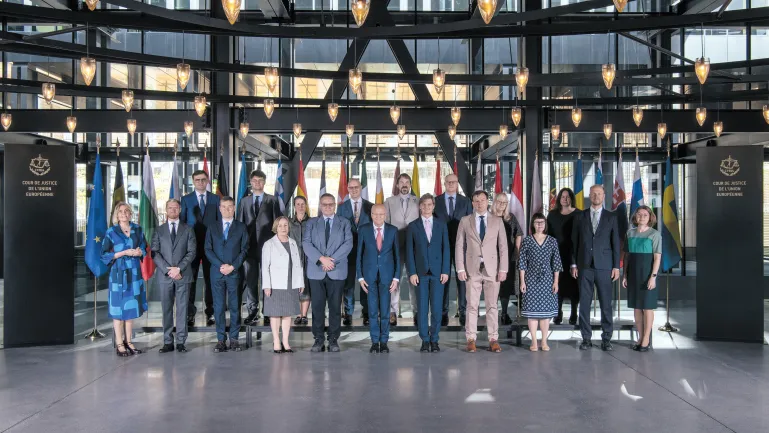
On September 7th and 8th, a delegation of the Supreme Court visited the Court of Justice of the European Union (CJEU) in Luxembourg. The visit included discussions on various legal issues, ranging from preliminary rulings to data protection in administrative and criminal proceedings.
The Supreme Court delegation was welcomed by the President of the Court of Justice, Koen Lenaerts, along with three judges from Estonia: Küllike Jürimäe, President of the Second Chamber of the Court of Justice, and Lauri Madise and Iko Nõmm, judges of the General Court.
In his welcoming remarks, Lenaerts emphasized the importance of judicial dialogue in the interpretation of European Union law, which is manifested, inter alia, in preliminary rulings. He highlighted several Estonian requests for a preliminary ruling that have had broad impact, influencing the legal order of the European Union as a whole (e.g., Prokuratuur, C-746/18).
President of the Supreme Court Villu Kõve noted in turn that preliminary ruling proceedings make it possible to arrive at solutions in complex and novel legal issues that are not only domestically justified, but also align with European Union law. At the same time, member state courts can thereby contribute to the development of EU law.
Kõve also drew attention to areas where cooperation between the Court of Justice of the European Union and member state courts could function even better. One such issue is the duration of preliminary ruling proceedings. Understandably, the questions submitted to the Court of Justice are often complex, concern multiple member states, and require thorough analysis. At the same time, in practice, the length of proceedings can mean years of legal uncertainty in important legal matters within a member state.
In her presentation, Supreme Court Justice Julia Laffranque provided an overview of the Estonian courts' past practice in requesting preliminary rulings. Since Estonia's accession to the European Union in May 2004, Estonian courts have submitted a total of 52 preliminary ruling requests to the Court of Justice, covering a very wide range of EU law fields—including tax law, public procurement, environmental law, consumer credit, and electronic surveillance.
Data protection in courts and criminal proceedings
A separate discussion was dedicated to the application of the General Data Protection Regulation (GDPR) in court proceedings. Supreme Court Justice Nele Siitam noted that GDPR has significantly influenced the practice of Estonian courts. According to her, the changes lie not so much in legal provisions as in the mindset and working methods of judges.
For instance, judges now pay greater attention to drafting court judgments in such a way that personal data is protected as effectively as possible and the risk of errors related to pseudonymisation upon the publication of a judgment is minimized. At the same time, parties to proceedings are also increasingly aware of their data protection rights and expect courts to handle their personal data with care. As a key topic, Siitam focused on state liability in situations where a court causes damage through a breach of data protection provisions in the course of administering justice.
Saale Laos, Chairman of the Criminal Chamber of the Supreme Court, addressed in her presentation the guarantees of effective judicial protection for individuals whose personal data is used in criminal proceedings. As key challenges, she highlighted the extensive or excessive collection of personal data, inadequate legal regulation and procedural safeguards, the excessive use and disclosure of lawfully collected personal data, and issues regarding the legal basis for collecting personal data as evidence. Growing challenges are also posed by the fact that a significant portion of evidentiary data is nowadays located in a digital environment.
Following the working sessions, the delegation visited the European Public Prosecutor's Office, whose structure and practice were introduced by Kristel Siitam-Nyiri, the first European Prosecutor appointed from Estonia. On the second day of the visit, the Supreme Court delegation also observed a Grand Chamber hearing of the Court of Justice in joined cases C-296/25 P and C-297/25 P, Poland v. Commission. Later judges Lauri Madise and Iko Nõmm introduced them to the tasks and recent case-law of the General Court.