

Supreme Court Justices Visited the European Court of Human Rights
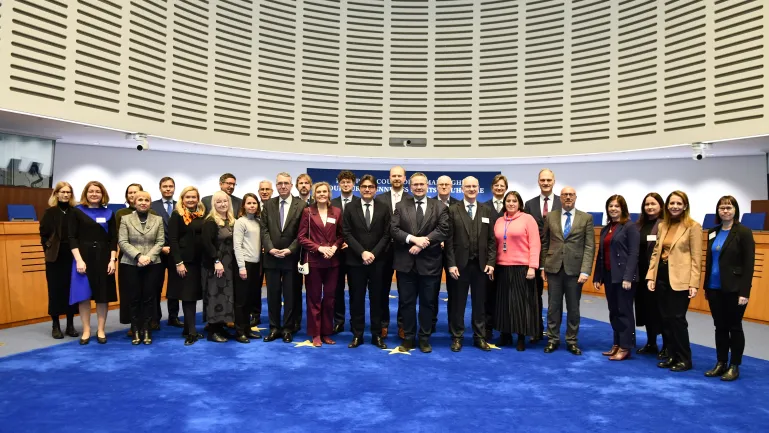
On January 21 and 22, 14 Supreme Court justices learned to know the work of the European Court of Human Rights (ECtHR) in Strasbourg and discussed current topics with colleagues, such as the harmonization of case law, heavy caseloads of courts, and judicial liability.
During the two-day visit, the Supreme Court delegation observed a Grand Chamber hearing at the ECtHR in the case of Kujit v. Netherlands and met with ECtHR President Mattias Guyomar, Estonian justice Peeter Roosma, and Court Registrar Marialena Tsirli, as well as several other justices and court officials.
One of the recurring themes in the meetings and discussions was how to ensure consistent case law, or in broader terms, the equal treatment of people in cases with similar content. Although certain differences are inevitable, divergence in practice becomes a problem when it is serious and prolonged. In the Supreme Court, issues causing disagreements can be referred, for example, to all members of a chamber, a special chamber, or Supreme Court en banc, but semi-official measures also exist, such as annual judges' roundtables.
Another major set of topics concerned judicial disciplinary liability and proceedings. In recent years, cases concerning the limits of judges' freedom of expression have reached the ECtHR. For instance, last year's judgment in Danilet v. Romania emphasized that when democracy or the rule of law is in serious danger, judges have the right to express their opinions in the general interest. In Estonia, the Supreme Court’s Disciplinary Chamber has issued an average of two decisions per year in recent years, primarily concerning violations of reasonable length of proceedings.
Since Estonian courts and the ECtHR have both faced issues with long proceedings and case backlogs, this matter was also examined in detail. As of last November, the review of 58,800 applications was pending at the ECtHR, whereas around 2010 the case backlog reached as high as 160,000. The situation at the ECtHR has been alleviated through organizational measures, such as having a single judge resolve certain cases single-handedly, handling repetitive applications in a simplified manner, prioritizing urgent cases etc.
Topics relevant to the Human Rights Court change over time depending on developments in the world and Europe. Currently, many environmental cases reach the court, and a new topic is bioethics and matters related to end-of-life advance directives. There continue to be numerous complaints regarding detention conditions, the duration of proceedings, and the enforcement of court judgments.
During the visit, the Supreme Court justices also met with Aino Lepik von Wirén, Estonia's Permanent Representative to the Council of Europe. At the Council of Europe, Estonia's current priority is clearly Ukraine. For example, there is a plan to establish a special tribunal in The Hague to investigate the crime of aggression committed against Ukraine and to create a compensation mechanism for repairing the war damages caused.
You can also watch a video about the visit on the ECtHR's YouTube channel.