

In the Supreme Court justice is administered by Administrative Law, Civil, Criminal and Constitutional Review Chambers and the Supreme Court en banc. Also a Special (ad hoc) Panel, consisting of members of different Chambers, is set up if necessary. The activities of Chambers are directed by chairmen. The chairmen and members of the Chambers are appointed by the Supreme Court en banc.
Administrative Law, Criminal and Civil Chambers
A matter is accepted for proceedings by a three-member panel of justices if the hearing thereof is demanded by at least one justice.
For the hearing of matters of cassation, petitions for review filed against court judgments the Supreme Court has Civil, Criminal and Administrative Law Chambers. The work of a Chamber is directed by the chairman of the Chamber. The chairman and members of a Chamber are appointed by the Supreme Court en banc on proposal of the President. On the request of the chairman of a Chamber, a member of some other Chamber may temporarily join the hearing of a matter.
Cases are heard in panels of at least 3 justices within the time limits provided for by procedural laws. If justices disagree on principle in matters concerning application of law or if the panel finds it necessary to change the former view of the Chamber on application of law, the matter shall be transferred to the whole composition of the Chamber for decision. If the full composition of a Chamber, upon examining a case and with regard to application of law, wants to assume a position different from that of any other Chamber of the Supreme Court in its last decision, the matter shall be transferred to a Special (ad hoc) Panel.
If during the hearing of a matter a Chamber comes to the conclusion that the applicable law or other legislation is in conflict with the Constitution, it shall not apply it, and if necessary, shall suspend the proceeding by a ruling. The ruling shall be transferred to the Constitutional Review Chamber for decision and to the Legal Chancellor, Riigikogu and Minister of Justice for information.
Chambers have their assisting personnel, whose composition and procedure of work is determined by the President of the Supreme Court and whose daily activities are governed by the chairmen of the Chambers.
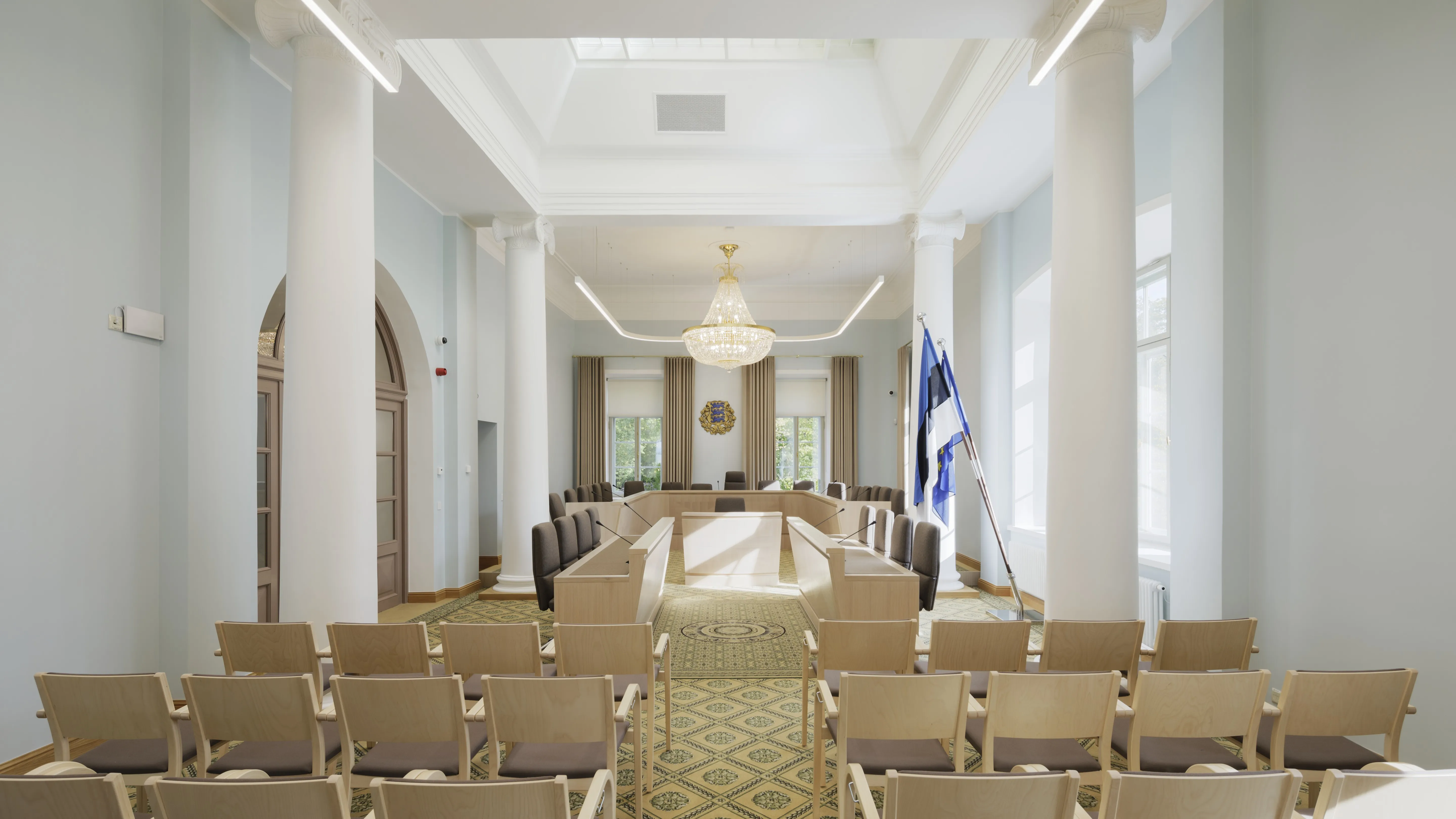
Room of the Supreme Court en banc, where public hearings take place. Photo: Maris Tomba
Constitutional Review Chamber
The Constitutional Review Chamber of the Supreme Court reviews the constitutionality of laws and other legislation of general application.
Every year, on the proposal of the President, the Supreme Court en banc appoints two new members to the Constitutional Review Chamber and releases two most senior members of the duties, taking into account the opinion of Administrative Law, Criminal and Civil Chambers and bearing in mind, as much as possible, their equal representation.
The Supreme Court adjudicates constitutional review cases either at the sessions of the Constitutional Review Chamber or sitting en banc. Constitutional Review Chamber hears cases in panels of at least three members.
A case may be transferred to Supreme Court en banc if:
- a petition to hear the case has been filed by another Chamber of the Supreme Court;
- the matter concerns essential constitutional issues;
- at least one justice on the panel has a dissenting opinion during the hearing of matter in Chamber;
- the judgment of the Supreme Court is necessary for changing the earlier practice of interpretation or judgment.
The Constitutional Review Chamber reviews:
- the constitutionality and legality of laws and resolutions adopted by the Riigikogu, which have entered into force;
- the constitutionality and legality of laws, which have not been promulgated by the President of the Republic and have not entered into force;
- the constitutionality of decrees issued by the President of the Republic, which have entered into force;
- the constitutionality of international treaties of the Republic of Estonia, which have not entered into force;
- constitutionality and legality of legislation of general application, issued by the executive and local governments, which have entered into force.
The Supreme Court shall declare wholly or partly invalid any law or other legislation, if it is in conflict with the spirit or provisions of the Constitution.
The Supreme Court shall:
- adjudicate requests for reviewing the constitutionality of legislation of general application;
- adjudicate requests for reviewing the constitutionality of international treaties;
- adjudicate complaints filed against the resolutions of the Riigikogu;
- adjudicate complaints filed against the resolutions of the Board of the Riigikogu;
- adjudicate complaints filed against the decisions of the President of the Republic;
- adjudicate requests for declaring a member of the Riigikogu, the President of the Republic, the Chancellor of Justice or the Auditor General is incapable of performing his or her duties for an extended period;
- adjudicate requests for termination of the authority of a member of the Riigikogu;
- decide on giving a consent to the Chairman of the Riigikogu, acting as President of the Republic, to declare extraordinary elections to the Riigikogu or to refuse to proclaim laws;
- adjudicate requests for termination of the activities of a political party;
- resolve complaints and protests filed against the decisions and acts of electoral committees.
The right to refer the matter to the court
The President of the Republic, the Riigikogu, the Chancellor of Justice and a municipal council can submit to the Supreme Court a request for review of the constitutionality of normative acts (or their non-adoption) and of international treaties.
- The President of the Republic may request that a law adopted by the Riigikogu (but which he or she has not yet promulgated) be declared unconstitutional.
- The Chancellor of Justice may request that a normative act in force adopted by the legislative branch, the executive branch, or a local authority body be declared null and void, in whole or in part. Similarly, he or she may refer a request to the Supreme Court seeking a declaration of unconstitutionality of a law promulgated but not yet in force, a normative act before its entry into force, or an international treaty signed by the Republic of Estonia.
- The Supreme Court also rules on requests from municipal councils seeking to declare unconstitutional a law or decree that is contrary to the constitutional guarantees granted to local authorities.
Furthermore, the Riigikogu may submit to the Supreme Court a request seeking its opinion on how to interpret the Constitution in conjunction with European Union law, if the interpretation of the Constitution is of decisive importance at the time of the adoption of a bill necessitated by the performance of obligations arising from Estonia's membership of the European Union.
Constitutional review may also be initiated by lower courts in the context of concrete review. During a trial, courts of first and second instance must refer a request for constitutional review to the Supreme Court after they have concluded that a normative act, an international treaty, or a provision thereof is contrary to the Constitution and have consequently left the contested norm unapplied.
In constitutional matters, individuals may only file a direct appeal with the Supreme Court in limited cases listed in the Constitutional Review Court Procedure Act and only when the purpose of the appeal is to protect their fundamental rights. Thus, any individual who believes their rights have been violated by a resolution of the Riigikogu or its Board, by a decision of the President of the Republic, or by a decision of an electoral committee, has the right to petition for the annulment of the act in question. The Court had the opportunity to reiterate this rule in a decision of March 23, 2005 (No. 3-4-1-6-05), emphasizing in particular that the Constitutional Review Court Procedure Act does not expressly provide for the possibility of filing an abstract individual complaint for the purpose of reviewing the constitutionality of normative acts.
During ordinary court proceedings, individuals may also raise an objection of unconstitutionality against a normative act applicable in the case at hand. If the court does not grant this request, a party to the proceedings has the option to request the initiation of constitutional review upon appeal or cassation. Outside of any legal proceedings, individuals also have the option of challenging the constitutionality of a normative act by turning to the Chancellor of Justice, who, if necessary, may refer the matter to the Supreme Court for the annulment of the act in question.
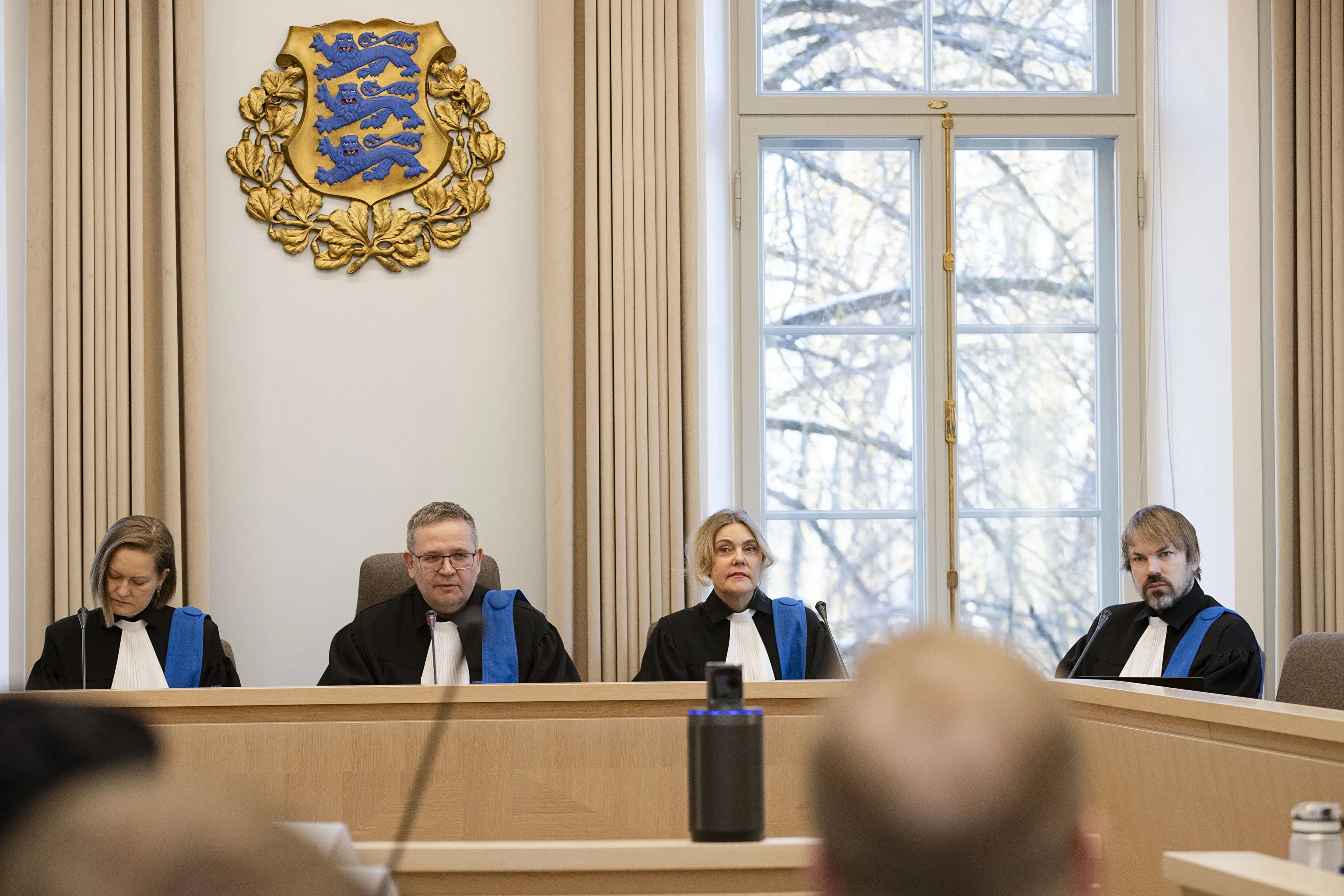
Public hearing of the Constitutional Review Chamber on February 3, 2026. From left: Supreme Court justices Heili Sepp, Villu Kõve, Julia Laffranque, and Vahur-Peeter Liin. Photo: Airika Harrik / ERR
Special Panel
Disputes of principle between Chambers concerning the application and interpretation of laws are resolved by Special (ad hoc) Panels. If the full composition of Civil, Criminal or Administrative Law Chamber, upon examining a case and with regard to application of law, wants to assume a position different from that of any other Chamber or Special panel of the Supreme Court in its last decision, the matter shall be transferred to a Special Panel. Two justices from each Chamber are elected to a Special Panel between two or three Chambers.
A session of the Special Panel is convened and chaired by the President of the Supreme Court. At the session of the Special Panel, the reporting judge is the chairman of the Chamber that petitioned for the convocation of Special Panel, or the reporting judge. The Special Panel decides cases pursuant to procedure prescribed by procedural laws. The decision is binding on all Chambers until the Special Panel itself or the Supreme Court en banc takes a different position concerning the issue.
Supreme Court en banc
The Supreme Court en banc is the highest body of the Supreme Court, comprising all 19 Supreme Court justices. The Supreme Court en banc is convened and its sessions are chaired by the President of the Supreme Court. The Supreme Court en banc has a quorum if at least 11 justices are present. Decisions are adopted by a majority vote of the justices present. In the event of a tie, the vote of the President of the Supreme Court is decisive.
The Supreme Court en banc:
- reviews court judgments in cases provided by law;
- makes a proposal to the President of the Republic to appoint a judge of a first or second instance court to office and to release a judge from office;
- resolves appeals filed against decisions of the Judge's Examination Committee and the Disciplinary Chamber of Judges;
- decides on the initiation of disciplinary proceedings against the President of the Supreme Court and informs the Riigikogu thereof;
- performs other tasks arising from law and the Internal Rules of Procedure of the Supreme Court.
When the Supreme Court en banc is not reviewing judgments, the Minister of Justice may also participate in the session with the right to speak. The President of the Supreme Court may also invite other persons to the Supreme Court en banc, to whom the Supreme Court en banc may grant the right to speak. In the interpretation of law, a decision of the Supreme Court en banc is binding on all chambers until the Supreme Court en banc has changed its position.